Why Spirituality Now?

Response from Ben Mann

As I am writing, I feel a distinct mourning and recognition of my own mortality. The world that has birthed my sentiment is one of heaviness and darkness. As a citizen of the United States, I have been relentlessly let down by the status quo of my own country. Despite being a nation of incredible resources and intelligence, we have allowed ourselves to fall prey to the deception of our own pride, which attempts to convince us that this life is an immortal one, and that in order to preserve it, we must subjugate one race, sexuality, gender, or class to another.

This choice has led to some dire outcomes, including injustice for people of color, women, poor people, people with disabilities, and LGBTQIA+ people – to name a few. It has also led to a system of governance that is quickly destroying our environment and exacerbating diseases and suffering. And, on an even more practical level, this choice makes it hard to just be a friend, neighbor, or employee, because it is hard to hope as our humanity decays – just as our mortal bodies do.

Against this backdrop of sadness, I offer that there is more, and that there is hope, yet it is so hard to recognize. Why? One theory: opportunism from the privileged and resourced who see hopelessness as a means to profit. Don’t believe me? During a recent trip to a major retailer, I noticed that the company posted signs in its windows reading, “You Matter”, “We are in this Together”, and the like. While I appreciate and agree with these messages, the fact that they are being offered by the design of a multi-billion dollar corporation seeking to profit, instead of a church or other community committed to the common good is disturbing. Companies like this one spend millions of dollars selling their products, and something in their expensive research informs them that the hopelessness that I describe is so valuable and so needed that it is worth building into the marketing of their products.

Nonetheless, against this backdrop, I offer that there are answers that can inoculate us from our own deceptions and the corporatization of our hope, and that is spirituality. Right away you might be tempted to shut out anything that follows, if you have not already done so by my use of flowery and stark language. Also, I am a pastor, so me saying the word “spirituality” conjures perceptions that I am about to attempt to sell you on my religion, a concept called proselytizing. 

So, let me be clear, I am not concerned with your belief matching mine or those held by my community, which vary wider than you might imagine. What does concern me is that you realize that the power and ability to adapt and grow even in the unhealthiest or threatening of circumstances resides within you. I think of that power as your spirit.

Some may call it your calling; others, your purpose, but whatever meaning you hear in those terms, I believe that we all have it; yet, like our mortal bodies, our spirits need to be coached, appreciated, exercised and treated for what ails them. We have been trained to think of spirituality – or the concept of understanding our spirits – as some form of cultish ritual or anti-intellectual escapism, we disregard wise advice and guidance that might otherwise help us find the hope that we need to counter the darkness.

An example from my own path: I found success in 12-step programming to address several personal challenges. Such programs are “spiritual” in their practice, because they ask participants to release some control over to a version of an external power. A dear friend has also found the same success in 12-step, but he HATES the concept of religion, and so has endeavored to shape the language of the program to meet his needs. Had my friend outright rejected the program, he would be in a toxic state.

This is a minor example of why we need spirituality now, because we have so limited our concept of spirit that it is preventing us from meeting our immediate needs for long-term growth and development, especially as humankind. In this shortcoming, however, there is much opportunity to become the resilient, capable people that can exceed our own expectations.

This is why I write, to be your partner and peer in what’s possible for you.

Response from Carrie E. Neal

For me, spirituality is liberation. Spirituality is experiential and activates meaning-making, connection, and maturity. It is about both being in the moment, and having a belief that there is more than just this moment. 

When asked, “Why Spirituality Now?”, I immediately find myself expanding outwards and think, “Spirituality Always”. If you are living in the United States in 2020, then you know that this has been a trying year. Living under a shelter in place order, unemployment, unsure political futures, and black siblings still being killed by police violence in very public ways. 

Now seems like the exact right time for spirituality. If spirituality can help us understand what’s happening in the world around us and inside us, then this seems to be the time to activate it. Friere tells us that authentic liberation is the process of humanization [1]. Now seems to be the perfect time for more humanizing systems, organizations, communities and relationships. Spirituality humanizes us and it liberates us.

When I think about the experience of being alive, the experience of 2020, I have a full range of emotions, many thoughts, plenty of fear and longing, and some hope. I also have rage, grief and deep sorrow. And mostly I think, “I, like every human who has lived, lives with both hope, and experiences trial, recognizing that most of my experience is out of my control. There has been pain at the level I experience today in every generation of humanity.”

What do I mean when I say spirituality activates meaning-making, connection, and maturity? 

My personal spirituality, as well as the cultural and societal environment that I exist within, give me language to process the world around me. If I believe that I should worry not for tomorrow (Matthew 6:34), and I am able to live into that, then I will experience the trials of 2020 in a very different way than someone whose spirituality teaches them to “share the guilt of creatureliness and the guilt for anything they ever thought.” [2] In this then, our spirituality informs our actions, our thoughts, our meaning-making and interpretation of experience. This recognition that spirituality is connected to my experience and allows for meaning-making releases me to the joy of the intellect. I love to think, research, and reflect. This is a spiritual practice for me. 

When I refer to connection I think about connection to self, connection to others, and connection to the Everything. The Everything that I can just begin to recognize when I get a sense of interbeing. Interbeing is an expanded inter-relational understanding of how we are situated and interact withtime, space, humanity before us, with us now and into the future, the natural world and all of life. [3] Connection to myself is how I understand inner-knowing. Connection to others is how I practice community. And connecting to Everything positions me with humility. 

And where does maturity fit in? When I think about maturity I think about personal and social development. I think about relationship to community. I think about recognizing transformation in myself and others. Maturity is a combination of synthesizing and assimilating observation, and making choices that honor oneself and one another. It is about presence, mindfulness and decision-making – it is wisdom. It is both earned and innate. 

So, how is spirituality liberation? I believe that believing in something more than ourselves is liberating, brings hope, helps us feel connected and interconnected, and increases empathy. This work – the work of being spiritual beings – becomes the work of humanization and interbeing. It is what moves us towards being people with ubuntu [4] and towards the future. It brings us equanimity, and peace. 

Wherever you are, in 2020 or any other point in time, I say, “Spirituality Always”.


[1] Freire, P. (2005) Pedagogy of the oppressed. New York: Continuum International Publishing Group.

[2] Baldwin, J., & Mead, M. (1971). A Rap on Race. Philadelphia and New York: J.B. Lippincott Company.

[3] Hạnh, T. (2020). Interbeing. Berkeley, CA: Parallax Press.

[4] “A person with ubuntu is open and available to others, affirming of others, does not feel threatened that others are able and good, for he or she has a proper self-assurance that comes from knowing that he or she belongs in a greater whole and is diminished when others are humiliated or diminished, when others are tortured or oppressed.” –Archbishop Desmond Tutu

Anti-Racism Roundtable

Originally presented on January 4, 2020. Originally posted on the YouTube on April 13, 2020.

Darren Calhoun, Rev. Nicole Garcia, DeRay McKesson, and I discuss the essential subject of anti-racism, our individual and collective responsibilities in the pursuit of equity, and its centrality to the work and mission of Q Christian Fellowship.

For an introduction into the premise “race is not real, but it is very important”, check out Vox’s fantastic video and explainer entitled

“The Myth of Race, Debunked in 3 Minutes”. This video was also shown during the presentation at Conference.

Find Carrie E. Neal here.

What does it mean to have an equitable classroom?

Originally posted on the Art History Teaching Resources Blog on January 4, 2019.

What does it mean to have an equitable classroom?

I believe that an equitable classroom is a place where each member remembers that each other member is a whole person. And, as instructors, we remember that even if the students are not content experts in the material being learned, they can engage in their own learning processes, grapple with material, and be a vital part of creating the teaching and learning environment.

How do we remember that the students, the learners in the room are people? How do we take their personal stories and lived experiences, however long or short, into account? How do we make sure that we are teaching through empowerment? What does that look like in an arts classroom? These are the questions that should be at the fore if we are truly interested in creating an equitable learning environment.

I believe we can create environments where each student is remembered. We can be more intentional in designing our curriculum, homework, deadlines, grading policies, and lesson plans. But first, we can be more intentional about who we are.

The environment in the room starts with us. This means checking our own biases and testing our motivations in decision-making, designing classroom systems, and developing curriculum. It means creating lesson plans based on social-emotional competencies (for ourselves and for our students’ development). It means being ready to learn from all of the humans in the room. It also means recognizing our power. By formal position we have the power and authority in the room. Yes, we make assessments, and assign grades, and we are paid to be there, but recognizing this power allows us to turn it on its head when possible. Manifesting the ideals of democratic education means leveraging our power to empower the students.

Creating an equitable classroom environment is about focusing on both equity and quality. There are many practical things we can do. We can give power back to the students through workshops, critiques, discussions, group-work and engaged activities. We can check our reading lists to make sure that there is gender, racial/ ethnic representation, and non-western traditions and voices included. We can keep checking ourselves for bias. We can de-gender our language. We can remember our students’ names (and pronounce them correctly). We can create community operational agreements. We can work to make the classroom expectation and norms visible by naming them. We can empower the students to define, record, and design their own behaviors and expressions in the room. 

It also means recognizing where we fit in a much larger educational, psycho-social system which has practices that contribute to inequalities in education. This is not because of the social, cultural or educational history of the individual student, but is larger and more complex.

Let’s take a metacognitive step. Let’s zoom out and make room in our thinking beyond our classroom. Let’s bring the value of pluralism to the way that we look at our teaching practices.  Let’s look beyond our individual experiences. Let’s even look beyond the experiences of our individual students. Let’s start educating ourselves about the institutions, theories, constraining forces, hidden (and not-so-hidden) oppressive systems, constructs and ideologies that underpin our society. We know that there are systems in place that reinforce racism, sexism, ableism, heteronormativity, xenophobias and socio-economic disparity. All of us encounter these structures and ideologies, but some of us (and our students) are affected more than others.

A student entering the classroom hungry will not perform as well as a student who is well fed. A student with access to a bank account for all of their books, materials and the tutoring they need, will have advantages over students who have financial constraints. I am not talking just about the students who are homeless, couch surfing, or working to pay for their books, but also those whose parents have re-mortgaged their homes to send their child to school, or those on scholarships and have the added high-stakes pressures of minimum GPAs and personal loans. 

We can recognize societal forces, see the learners in our classrooms, and make change. We can leverage our positions. We can focus on equity in our classrooms. We can increase inclusive practices. We can educate ourselves on white supremacy and how to dismantle the effects of it in our minds and behavior patterns. We can invite and value diversity in our classrooms, our teaching practices, and the perspectives of every person in our rooms.

There is always more that we can do. We can create classroom policies that respect the struggles of our students who are not well served by the current educational system. We can believe that sometimes what is fair and equitable may include differentiated policies to allow for equal access, equal chance for success. We can resource our students who have greater needs because of systemic societal and educational shortcomings. (Resourcing can include additional time on written assignments for English language learners, flexible grading policies for students in crisis, following the recommendations of the school’s Disability Services office for accommodations, being mindful of the cost of materials when we ask students to have access to technology not provided by the school, and keeping open communication with our students.)

We can also recognize that what we do in our classrooms is only a tiny part of the picture. Let’s engage the entrenched biases, stereotypes and discrimination in ourselves, our institutions, and in our society through critical deconstruction.

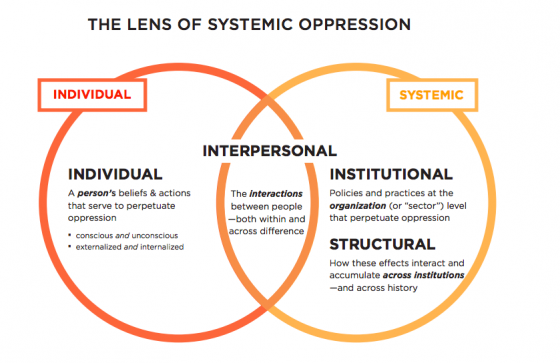
See more at The National Equity Project


There are systemic oppressive forces at play in all of our lives. The ways that they impact us will vary based on our privilege. Let’s do our own work. Let’s own our privilege. Let’s check our internalized individual biases. Let’s be intentional about our behaviors, our language, our presentation of ourselves inside and outside of the classroom.

The place where our individual perspectives meets the larger systemic forces is though interpersonal interactions. Our classrooms are spaces full of interpersonal interactions. By spending time to intentionally develop projects that bring the thoughts and feelings of all of our students into the room, by focusing on social-emotional competencies, and through the kinds of inclusive and equitable practices mentioned above, we may just take a few steps forward in actually aligning the ideals of democratic education with the current realities.

As we reflect on the New Year, and the return to our classrooms, let’s ask ourselves what we could be doing differently.


Questions for Reflection:

  • What is an equitable teaching and learning environment in my classroom, with these students, and the content I am teaching?
  • Am I using community operational agreements? Is it a good time to revisit them? Can I find the time to name norms with them, and develop new agreements for the new year?
  • Have I/ How have I set up the operating processes (socially and logistically) in my classroom? Are the systems that I have set up equitable, practical and sustainable? DO all of the participants in the class know the operating processes?
  • What am I currently doing to develop my pedagogic practice? What do I need more work in? Could I ask a colleague where they think my blind-spots are.
  • What have I done recently to cultivate curiosity and empathy in myself?
  • How can I see and work on my own biases?
  • In what ways are my classes inclusive of a range of experiences, artists, perspectives and attentive to structural and ideological power (e.g. racism, sexism, classism, learning differences etc.?)
  • What kinds of critiques and assessments have I developed? Are they equitable? Do they empower the students? Do they need to be revisited?
  • Have I built in enough different approaches to learning and ways for the students to evidence their learning (e.g., writing, speaking, making, small groups / big groups / one-on-one, language support, etc.)?
  • What work do I need to do to cultivate social-emotional competencies in me? How can I support this development in the students?
  • What are my beliefs about equity in the classroom and am I public about it? Should I be more public about my stance on equity, diversity and inclusion (with the students, parents, colleagues and administrators)?

Support That Meets You Where You Are:
If you want structure and a companion in this work, 1:1 coaching offers thought partnership, parts‑aware practices, and practical plan‑building: Transformative Coaching. Group spaces explore resilience, identity, and emotional intelligence with community support: Classes & Groups. For organizations, facilitation can align structures with human needs so people have room to move forward: Consulting.

Find Carrie E. Neal here.

Mental Fatigue: What can I do?

I’m writing this at 1am. I have finally finished all of my other to-do’s for the day. I am not in top mental condition at the moment. I am tired. I can feel my mind wander. My bed is calling my name. And yet, there is a part of me that is endlessly interested in writing this post.

Irony drumroll please: This is a post on mental fatigue.

I can feel mental fatigue set in. I have a pretty decent stamina for making decisions, being alert and focused, toggling between reading, writing, talking, holding space for others, and my own perceptions. But, when I am exhausted mentally, I feel it physically. Sometimes I can’t make decisions. Sometimes I lose my concentration within a matter of seconds. My short term memory is effected and I have trouble expressing myself verbally.

For many us mental fatigue or exhaustion may be a result of cognitive load from our work life, our family life, personal conflict, conflict in society, or our choices (e.g. lack of quality sleep). Mental fatigue in healthy individuals can be observed and measured neurologically. When we are mentally tired it effects us.

So, what can we do?

1. Make better choices. (I will do this… starting tomorrow.)

* Get plenty of sleep. Mental fatigue may exist no matter how much sleep you get, but sleep does help refresh your body and mind. There is new research about how the nervous system responds to rest. Additionally sleep allows for processes that create change and restoration at the cellular level. Don’t underestimate the power of sleep!

2. Take personal time.

This may seem unattainable, but even a cup of coffee, 5 minutes of bathroom reading, or a favorite podcast on your subway ride can create rest. I love to recommend taking a day long vacation, and taking time alone, but I know that is not attainable for many of us. If you can – take yourself on a date (alone).

* Take a day in which you can do things by yourself. Take yourself out to a movie, go to a museum or art gallery, or do something you’ve always wanted to do but never made time for. In doing so, you’ll be able to enjoy the peace and quiet of being alone.

3. Reflect.

Reflection is different for each person. Depending on your learning styles, personality and life situation, how you reflect may take many forms. I am the kind of person who likes to reflect in silence. Often the few minutes before I fall asleep at night is my time to reflect. Often this is my time to think through my day, identify synchronicities, and engage gratitude.

* Spend some time reflecting. Try to make this protected time, and a habit. Everyone has a different way of self-reflection. Some pray or meditate, others write in a journal or diary, while others simply allow their thoughts to gently release. Sometimes it helps to do something repetitive, like SAORI weaving, or adult coloring books, or a walking meditation. Try different ways to reflect until you know what king of reflecting practices work for you.

4. Get distracted. (Yes, I said it.)

Many of us are taught to dwell on what is bothering us. Sometimes the dwelling is masked as problem-solving. Thinking about the same things over and over only reifies the thoughts, making it harder to think new thoughts. I find that when I am conscious of my swirling thoughts I have an opportunity to disrupt that thinking. Distraction can be an excellent disrupter. I find myself going to productive distractions (like cooking or quilting) that both feed me and disrupt my swirling mind.

* Take your mind off of those things that are causing you stress by working on a puzzle or spending time with friends and family. You could remind yourself an interest that you have and engage in that, or watch some online videos (kittens anyone?). You could even let yourself engage in beginner’s mind and learn a new craft, skill or art.

5. Move our bodies.

Not all of us take the time to remember that we are incarnate. I find myself spending much of my time attending to thoughts and emotions, and much less time remembering that I am embodied. Not all of us are able-bodied, but for those of us who can move – let’s take advantage of that.

* Gentle movement, aware movement, traditional HIIT training and low impact movement all support our immune systems, our mental health, and our brain health. And depending on the kind of movement, you may also be releasing endorphins. These are brain chemicals which make us feel happy! It’s like the body’s natural “high.” Even if all you can do is take a 15-minute walk, take it.

6. Remember to breathe.

* Try breathing exercises. Cultures have been using breathing exercises to reduce stress for some 8000 years. You can find some exercises recommended by Michigan Medicine at the University of Michigan in the Citations below.

Don’t forget how creative you are!

These are just some strategies to combat mental fatigue. You may have some other methods that help you relax and find peace in your life. It may seem like a lot to try to address mental fatigue (mostly because we are tired thinking about making decisions, planning or strategizing may add to the mental fatigue in the moment). Maybe the key is to stop thinking and begin doing. Or, if you are like me, stop doing, and go to bed before midnight!

An anti‑oppressive note:
Mental fatigue is not a personal failure. It emerges within real contexts—workload and labor precarity, caregiving demands, systemic racism and sexism, ableism, economic stress, unsafe housing, health disparities, and ongoing collective trauma. These conditions shape attention, sleep, mood, and energy. The aim isn’t to “power through” or self‑blame; it’s to restore choice and care in the present while honoring constraints and identities.

Want more?
Download this worksheet to continue your reflective practice:

Mental Fatigue Worksheet

Support That Meets You Where You Are:
If you want structure and a companion in this work, 1:1 coaching offers thought partnership, parts‑aware practices, and practical plan‑building: Transformative Coaching. Group spaces explore resilience, identity, and emotional intelligence with community support: Classes & Groups. For organizations, facilitation can align structures with human needs so people have room to move forward: Consulting.

Find Carrie E. Neal here.


For some additional nerdy reading: