Why Spirituality Now?

Response from Ben Mann

As I am writing, I feel a distinct mourning and recognition of my own mortality. The world that has birthed my sentiment is one of heaviness and darkness. As a citizen of the United States, I have been relentlessly let down by the status quo of my own country. Despite being a nation of incredible resources and intelligence, we have allowed ourselves to fall prey to the deception of our own pride, which attempts to convince us that this life is an immortal one, and that in order to preserve it, we must subjugate one race, sexuality, gender, or class to another.

This choice has led to some dire outcomes, including injustice for people of color, women, poor people, people with disabilities, and LGBTQIA+ people – to name a few. It has also led to a system of governance that is quickly destroying our environment and exacerbating diseases and suffering. And, on an even more practical level, this choice makes it hard to just be a friend, neighbor, or employee, because it is hard to hope as our humanity decays – just as our mortal bodies do.

Against this backdrop of sadness, I offer that there is more, and that there is hope, yet it is so hard to recognize. Why? One theory: opportunism from the privileged and resourced who see hopelessness as a means to profit. Don’t believe me? During a recent trip to a major retailer, I noticed that the company posted signs in its windows reading, “You Matter”, “We are in this Together”, and the like. While I appreciate and agree with these messages, the fact that they are being offered by the design of a multi-billion dollar corporation seeking to profit, instead of a church or other community committed to the common good is disturbing. Companies like this one spend millions of dollars selling their products, and something in their expensive research informs them that the hopelessness that I describe is so valuable and so needed that it is worth building into the marketing of their products.

Nonetheless, against this backdrop, I offer that there are answers that can inoculate us from our own deceptions and the corporatization of our hope, and that is spirituality. Right away you might be tempted to shut out anything that follows, if you have not already done so by my use of flowery and stark language. Also, I am a pastor, so me saying the word “spirituality” conjures perceptions that I am about to attempt to sell you on my religion, a concept called proselytizing. 

So, let me be clear, I am not concerned with your belief matching mine or those held by my community, which vary wider than you might imagine. What does concern me is that you realize that the power and ability to adapt and grow even in the unhealthiest or threatening of circumstances resides within you. I think of that power as your spirit.

Some may call it your calling; others, your purpose, but whatever meaning you hear in those terms, I believe that we all have it; yet, like our mortal bodies, our spirits need to be coached, appreciated, exercised and treated for what ails them. We have been trained to think of spirituality – or the concept of understanding our spirits – as some form of cultish ritual or anti-intellectual escapism, we disregard wise advice and guidance that might otherwise help us find the hope that we need to counter the darkness.

An example from my own path: I found success in 12-step programming to address several personal challenges. Such programs are “spiritual” in their practice, because they ask participants to release some control over to a version of an external power. A dear friend has also found the same success in 12-step, but he HATES the concept of religion, and so has endeavored to shape the language of the program to meet his needs. Had my friend outright rejected the program, he would be in a toxic state.

This is a minor example of why we need spirituality now, because we have so limited our concept of spirit that it is preventing us from meeting our immediate needs for long-term growth and development, especially as humankind. In this shortcoming, however, there is much opportunity to become the resilient, capable people that can exceed our own expectations.

This is why I write, to be your partner and peer in what’s possible for you.

Response from Carrie E. Neal

For me, spirituality is liberation. Spirituality is experiential and activates meaning-making, connection, and maturity. It is about both being in the moment, and having a belief that there is more than just this moment. 

When asked, “Why Spirituality Now?”, I immediately find myself expanding outwards and think, “Spirituality Always”. If you are living in the United States in 2020, then you know that this has been a trying year. Living under a shelter in place order, unemployment, unsure political futures, and black siblings still being killed by police violence in very public ways. 

Now seems like the exact right time for spirituality. If spirituality can help us understand what’s happening in the world around us and inside us, then this seems to be the time to activate it. Friere tells us that authentic liberation is the process of humanization [1]. Now seems to be the perfect time for more humanizing systems, organizations, communities and relationships. Spirituality humanizes us and it liberates us.

When I think about the experience of being alive, the experience of 2020, I have a full range of emotions, many thoughts, plenty of fear and longing, and some hope. I also have rage, grief and deep sorrow. And mostly I think, “I, like every human who has lived, lives with both hope, and experiences trial, recognizing that most of my experience is out of my control. There has been pain at the level I experience today in every generation of humanity.”

What do I mean when I say spirituality activates meaning-making, connection, and maturity? 

My personal spirituality, as well as the cultural and societal environment that I exist within, give me language to process the world around me. If I believe that I should worry not for tomorrow (Matthew 6:34), and I am able to live into that, then I will experience the trials of 2020 in a very different way than someone whose spirituality teaches them to “share the guilt of creatureliness and the guilt for anything they ever thought.” [2] In this then, our spirituality informs our actions, our thoughts, our meaning-making and interpretation of experience. This recognition that spirituality is connected to my experience and allows for meaning-making releases me to the joy of the intellect. I love to think, research, and reflect. This is a spiritual practice for me. 

When I refer to connection I think about connection to self, connection to others, and connection to the Everything. The Everything that I can just begin to recognize when I get a sense of interbeing. Interbeing is an expanded inter-relational understanding of how we are situated and interact withtime, space, humanity before us, with us now and into the future, the natural world and all of life. [3] Connection to myself is how I understand inner-knowing. Connection to others is how I practice community. And connecting to Everything positions me with humility. 

And where does maturity fit in? When I think about maturity I think about personal and social development. I think about relationship to community. I think about recognizing transformation in myself and others. Maturity is a combination of synthesizing and assimilating observation, and making choices that honor oneself and one another. It is about presence, mindfulness and decision-making – it is wisdom. It is both earned and innate. 

So, how is spirituality liberation? I believe that believing in something more than ourselves is liberating, brings hope, helps us feel connected and interconnected, and increases empathy. This work – the work of being spiritual beings – becomes the work of humanization and interbeing. It is what moves us towards being people with ubuntu [4] and towards the future. It brings us equanimity, and peace. 

Wherever you are, in 2020 or any other point in time, I say, “Spirituality Always”.


[1] Freire, P. (2005) Pedagogy of the oppressed. New York: Continuum International Publishing Group.

[2] Baldwin, J., & Mead, M. (1971). A Rap on Race. Philadelphia and New York: J.B. Lippincott Company.

[3] Hạnh, T. (2020). Interbeing. Berkeley, CA: Parallax Press.

[4] “A person with ubuntu is open and available to others, affirming of others, does not feel threatened that others are able and good, for he or she has a proper self-assurance that comes from knowing that he or she belongs in a greater whole and is diminished when others are humiliated or diminished, when others are tortured or oppressed.” –Archbishop Desmond Tutu

Anti-Racism Roundtable

Originally presented on January 4, 2020. Originally posted on the YouTube on April 13, 2020.

Darren Calhoun, Rev. Nicole Garcia, DeRay McKesson, and I discuss the essential subject of anti-racism, our individual and collective responsibilities in the pursuit of equity, and its centrality to the work and mission of Q Christian Fellowship.

For an introduction into the premise “race is not real, but it is very important”, check out Vox’s fantastic video and explainer entitled

“The Myth of Race, Debunked in 3 Minutes”. This video was also shown during the presentation at Conference.

Find Carrie E. Neal here.

What does it mean to have an equitable classroom?

Originally posted on the Art History Teaching Resources Blog on January 4, 2019.

What does it mean to have an equitable classroom?

I believe that an equitable classroom is a place where each member remembers that each other member is a whole person. And, as instructors, we remember that even if the students are not content experts in the material being learned, they can engage in their own learning processes, grapple with material, and be a vital part of creating the teaching and learning environment.

How do we remember that the students, the learners in the room are people? How do we take their personal stories and lived experiences, however long or short, into account? How do we make sure that we are teaching through empowerment? What does that look like in an arts classroom? These are the questions that should be at the fore if we are truly interested in creating an equitable learning environment.

I believe we can create environments where each student is remembered. We can be more intentional in designing our curriculum, homework, deadlines, grading policies, and lesson plans. But first, we can be more intentional about who we are.

The environment in the room starts with us. This means checking our own biases and testing our motivations in decision-making, designing classroom systems, and developing curriculum. It means creating lesson plans based on social-emotional competencies (for ourselves and for our students’ development). It means being ready to learn from all of the humans in the room. It also means recognizing our power. By formal position we have the power and authority in the room. Yes, we make assessments, and assign grades, and we are paid to be there, but recognizing this power allows us to turn it on its head when possible. Manifesting the ideals of democratic education means leveraging our power to empower the students.

Creating an equitable classroom environment is about focusing on both equity and quality. There are many practical things we can do. We can give power back to the students through workshops, critiques, discussions, group-work and engaged activities. We can check our reading lists to make sure that there is gender, racial/ ethnic representation, and non-western traditions and voices included. We can keep checking ourselves for bias. We can de-gender our language. We can remember our students’ names (and pronounce them correctly). We can create community operational agreements. We can work to make the classroom expectation and norms visible by naming them. We can empower the students to define, record, and design their own behaviors and expressions in the room. 

It also means recognizing where we fit in a much larger educational, psycho-social system which has practices that contribute to inequalities in education. This is not because of the social, cultural or educational history of the individual student, but is larger and more complex.

Let’s take a metacognitive step. Let’s zoom out and make room in our thinking beyond our classroom. Let’s bring the value of pluralism to the way that we look at our teaching practices.  Let’s look beyond our individual experiences. Let’s even look beyond the experiences of our individual students. Let’s start educating ourselves about the institutions, theories, constraining forces, hidden (and not-so-hidden) oppressive systems, constructs and ideologies that underpin our society. We know that there are systems in place that reinforce racism, sexism, ableism, heteronormativity, xenophobias and socio-economic disparity. All of us encounter these structures and ideologies, but some of us (and our students) are affected more than others.

A student entering the classroom hungry will not perform as well as a student who is well fed. A student with access to a bank account for all of their books, materials and the tutoring they need, will have advantages over students who have financial constraints. I am not talking just about the students who are homeless, couch surfing, or working to pay for their books, but also those whose parents have re-mortgaged their homes to send their child to school, or those on scholarships and have the added high-stakes pressures of minimum GPAs and personal loans. 

We can recognize societal forces, see the learners in our classrooms, and make change. We can leverage our positions. We can focus on equity in our classrooms. We can increase inclusive practices. We can educate ourselves on white supremacy and how to dismantle the effects of it in our minds and behavior patterns. We can invite and value diversity in our classrooms, our teaching practices, and the perspectives of every person in our rooms.

There is always more that we can do. We can create classroom policies that respect the struggles of our students who are not well served by the current educational system. We can believe that sometimes what is fair and equitable may include differentiated policies to allow for equal access, equal chance for success. We can resource our students who have greater needs because of systemic societal and educational shortcomings. (Resourcing can include additional time on written assignments for English language learners, flexible grading policies for students in crisis, following the recommendations of the school’s Disability Services office for accommodations, being mindful of the cost of materials when we ask students to have access to technology not provided by the school, and keeping open communication with our students.)

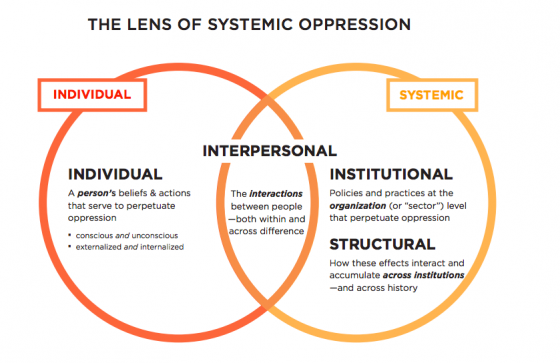
We can also recognize that what we do in our classrooms is only a tiny part of the picture. Let’s engage the entrenched biases, stereotypes and discrimination in ourselves, our institutions, and in our society through critical deconstruction.

See more at The National Equity Project


There are systemic oppressive forces at play in all of our lives. The ways that they impact us will vary based on our privilege. Let’s do our own work. Let’s own our privilege. Let’s check our internalized individual biases. Let’s be intentional about our behaviors, our language, our presentation of ourselves inside and outside of the classroom.

The place where our individual perspectives meets the larger systemic forces is though interpersonal interactions. Our classrooms are spaces full of interpersonal interactions. By spending time to intentionally develop projects that bring the thoughts and feelings of all of our students into the room, by focusing on social-emotional competencies, and through the kinds of inclusive and equitable practices mentioned above, we may just take a few steps forward in actually aligning the ideals of democratic education with the current realities.

As we reflect on the New Year, and the return to our classrooms, let’s ask ourselves what we could be doing differently.


Questions for Reflection:

  • What is an equitable teaching and learning environment in my classroom, with these students, and the content I am teaching?
  • Am I using community operational agreements? Is it a good time to revisit them? Can I find the time to name norms with them, and develop new agreements for the new year?
  • Have I/ How have I set up the operating processes (socially and logistically) in my classroom? Are the systems that I have set up equitable, practical and sustainable? DO all of the participants in the class know the operating processes?
  • What am I currently doing to develop my pedagogic practice? What do I need more work in? Could I ask a colleague where they think my blind-spots are.
  • What have I done recently to cultivate curiosity and empathy in myself?
  • How can I see and work on my own biases?
  • In what ways are my classes inclusive of a range of experiences, artists, perspectives and attentive to structural and ideological power (e.g. racism, sexism, classism, learning differences etc.?)
  • What kinds of critiques and assessments have I developed? Are they equitable? Do they empower the students? Do they need to be revisited?
  • Have I built in enough different approaches to learning and ways for the students to evidence their learning (e.g., writing, speaking, making, small groups / big groups / one-on-one, language support, etc.)?
  • What work do I need to do to cultivate social-emotional competencies in me? How can I support this development in the students?
  • What are my beliefs about equity in the classroom and am I public about it? Should I be more public about my stance on equity, diversity and inclusion (with the students, parents, colleagues and administrators)?

Support That Meets You Where You Are:
If you want structure and a companion in this work, 1:1 coaching offers thought partnership, parts‑aware practices, and practical plan‑building: Transformative Coaching. Group spaces explore resilience, identity, and emotional intelligence with community support: Classes & Groups. For organizations, facilitation can align structures with human needs so people have room to move forward: Consulting.

Find Carrie E. Neal here.

Reflective Prompts about Building Self‑Trust


Self‑reliance is a practice: choosing steady self‑trust, learning from experience, and taking responsibility for our path. Reflective prompts can help you notice what’s real, pick a next step, and make meaning from what you discover. Journaling them—briefly, consistently—reveals patterns, strengthens confidence, and turns uncertainty into direction. You don’t need breakthroughs; you need clear cues and doable moves. Use these prompts to support growth, meaning‑making, and the kind of revelation that comes from paying careful attention.

How to use this post:

  • Read one item a day, or scan for what resonates right now.
  • Ask yourself each prompt and write two or three lines in response—enough to be honest, not exhaustive.
  • Keep a sustainable pace. Progress beats perfection.
  • Revisit your notes weekly to notice shifts in energy, focus, and care.

Reflections for Self-Trust:

  1. I acknowledge that demonstrating self‑reliance strengthens my confidence.
    Ask yourself: Where did I rely on myself effectively this week?
  2. Life can be exhilarating, joyful, and uncertain; I meet the unknown with steady self‑trust.
    Ask yourself: What uncertainty is present, and what is one way I can steady myself?
  3. I define self‑reliance as directing my path and taking responsibility for my choices.
    Ask yourself: What decision am I ready to make without outsourcing my clarity?
  4. I plot my own direction with care, data, and intuition.
    Ask yourself: What information and inner cue both point to my next step?
  5. I am capable; I don’t need perfection to take action.
    Ask yourself: What imperfect action will move this forward today?
  6. My self‑sufficiency comforts me; I am okay regardless of outcomes.
    Ask yourself: What evidence reminds me I can handle whatever happens?
  7. Confidence grows when I pause, assess options, and choose a path.
    Ask yourself: Which option aligns with my values and the outcomes I want?
  8. I learn from experience—mine and others’—to deepen wisdom and skill.
    Ask yourself: Whose insight could sharpen my approach, and how will I apply it?
  9. Healthy self‑reliance includes knowing when to ask for help and how to receive it.
    Ask yourself: What support would make this more effective while I stay accountable?
  10. I set clear boundaries that protect my time, energy, and focus.
    Ask yourself: What boundary needs stating or reinforcing today?
  11. I build resilience through consistent practice and honest reflection.
    Ask yourself: What small routine will strengthen my self‑trust this week?
  12. Today, I demonstrate self‑reliance with one concrete, values‑aligned action.
    Ask yourself: What single commitment will I complete before the day ends?

Compassionate Systemic Thinking; Self‑Reliance with an Anti‑Oppression Lens:

  1. I practice self‑reliance while recognizing the systems I’m part of and how they shape my choices.
    Ask yourself: What personal action and what system condition both need attention today?
  2. Confidence grows when self‑reliance centers dignity, equity, and harm reduction.
    Ask yourself: Whose dignity is affected by my decision—and how am I protecting it?
  3. I direct my path while sharing power and increasing access where I can.
    Ask yourself: Where can I redistribute decision‑making or resources concretely?
  4. I assess my role, privileges, and impacts with honesty and care.
    Ask yourself: What advantage I hold can be leveraged for fairness right now?
  5. Accountability strengthens my self‑trust; I name harms—even unintended—and repair.
    Ask yourself: Who was affected, and what repair or change do I owe?
  6. Discomfort can signal growth; I choose accountability over defensiveness.
    Ask yourself: What accountability step is clear, proportional, and timely?
  7. I listen, believe feedback, and adjust my impact in relationships and work.
    Ask yourself: What feedback will I act on—and what specific change will I make?
  8. I communicate with consent, clarity, and follow‑through.
    Ask yourself: How can I check for consent and understanding before moving forward?
  9. I measure outcomes over intent and learn without deflecting responsibility.
    Ask yourself: What outcome matters most—and how will I track it?
  10. I set boundaries that protect well‑being and reduce harm for myself and others.
    Ask yourself: What boundary or policy needs revisiting to improve safety and belonging?
  11. I build resilience through consistent practice, community care, and shared learning.
    Ask yourself: What routine and what partnership will strengthen my follow‑through?
  12. Today, I take one values‑aligned action that improves conditions beyond me.
    Ask yourself: What small, real step will shift access, safety, or care for someone else?

Support That Meets You Where You Are:
If you want structure and a companion in this work, 1:1 coaching offers thought partnership, parts‑aware practices, and practical plan‑building: Transformative Coaching. Group spaces explore resilience, identity, and emotional intelligence with community support: Classes & Groups. For organizations, facilitation can align structures with human needs so people have room to move forward: Consulting.

Find Carrie E. Neal here.

Decision Fatigue: What It Is and How to Reduce It

We’ve all felt it: after a day of nonstop choices—messages answered, meetings scheduled, errands squeezed in—our brain starts to slide. We overbuy, say yes when we mean no, or grab whatever snack is closest. Decision fatigue is the slowdown of judgment and self‑regulation after repeated decisions. As the load rises, two shortcuts tend to show up: we choose too quickly and recklessly or we avoid deciding altogether.

What decision fatigue looks like: (Maybe some of these are familiar to you. They are to me!)

Diminished judgment as the day goes on. As our decision load accumulates, we get noisier at choices and quicker to react. By evening, we’re more likely to:

  • Argue or snap over small frictions (who’s doing dishes, bedtime routines, calendar changes) because cognitive bandwidth is low and we default to emotional shortcuts.
  • Impulse‑spend online—adding “just one more” item to the cart or saying yes to a subscription—because clicking “buy” feels easier than deliberating.
  • Reach for convenience foods and skip planned prep; late‑night snacks and takeout are classic fatigue shortcuts when cooking requires micro‑decisions.
  • Say yes to invitations or tasks we’d normally decline, simply to end the decision and move on.
    A simple counter: front‑load key choices, pre‑decide meals, and add an evening “no‑commitments” rule unless the decision passes a 24‑hour check.

Avoidance and procrastination. When our brain is saturated, “I can’t decide right now” often morphs into “I won’t decide at all.” We defer, then forget, then feel behind.

  • Bills and admin tasks get punted; late fees appear not because we didn’t know the right move, but because we couldn’t face the choice stack.
  • Work items stall at the point of choosing—draft A vs. B, schedule now vs. later—so projects linger in limbo.
  • We keep multiple tabs open or lists half‑made, which compounds load and further delays action.
    A simple counter: use a two‑step rule—choose the next action (not the whole plan), then time‑box it (10–20 minutes). If a decision remains fuzzy, set a “good‑enough” default (e.g., pay minimum, schedule 30 minutes, pick A) with a calendar revisit.

Self‑regulation dips. Willpower and patience feel scarce, so fatigue drives shortcuts: fast, familiar, and often misaligned with our goals.

  • We choose the “easy/safe” option (deny, defer, default) rather than the right one that needs thought or a conversation.
  • We accept status‑quo settings—auto‑renewals, default permissions, default routes—even when they cost more or reduce safety, because changing them takes effort.
  • We abandon helpful routines (movement, stretching, journaling) and skip small steps that keep the day steady.
  • In relationships, we “solution‑drop” (offer a quick fix) instead of listening, because listening is a high‑effort choice.

Everyday systems to protect our energy and values:

  • Make important decisions early, in calm windows. Morning or low‑stress moments help our head and gut cooperate. Even 10 minutes in a quiet place can improve the outcome.
  • Choose clothes the night before. Or narrow the wardrobe (uniforms or simple mixes). Fewer early decisions mean more energy for what matters.
  • Plan the day before bed. Name tomorrow’s top three, block time, and pre‑decide meals. We wake to execution, not endless micro‑choices.
  • Keep life simple where you can. Complexity is cognitively expensive. Trim systems, reduce clutter, consolidate tools. A simpler setup makes better decisions easier.
  • Delegate and democratize choices. Let a partner pick the restaurant, a colleague own a small project call, or kids choose the weekend activity. Shared decisions build trust and reduce load.
  • Take a short nap. Even 10–30 minutes can restore focus and self‑control. If naps aren’t possible, try a brief reset: a walk, breathwork, or quiet pause.
  • Know our priorities. Clear values turn many choices into quick, clean moves. If health, family time, and learning are top priorities, we can align fast and stop over‑torturing ourselves.

A note to leaders, and about leadership:
Leaders face layered decision loads—personal, team, and organizational. When we hit fatigue, the risks ripple outward. Two practices help:

  • Decision tiers: define which decisions are strategic (we own), tactical (we co‑own), and operational (others own within guardrails). This reduces bottlenecks and builds trust.
  • Decision hygiene: use small checklists, time boxes, and “front page” tests (would we be comfortable with this being public?) for higher‑stakes calls. Protect our peak hours for the decisions that need us most.

An anti-oppressive note:

Decision fatigue does not affect everyone equally. Systemic forces—racism, sexism, ableism, transphobia, xenophobia—along with economic challenges, immigration status, caregiving responsibilities, disability, health, and access to transit, housing, and safe workplaces shape both the number of decisions individuals must carry and the costs those decisions impose.

In practical terms, this means:

  • Uneven decision load. Marginalized groups often navigate additional, high‑stakes choices (e.g., route safety, documentation requirements, accommodation requests, bias management), increasing daily cognitive burden beyond routine work and home decisions.
  • Higher access costs. Time, money, and energy spent securing childcare, transit, healthcare, or workplace accommodations amplify fatigue and reduce capacity for later decisions.
  • Safety as a decision criterion. Choices that seem minor for some (e.g., attending an evening meeting, using a particular transit line) carry safety considerations for others, changing the calculation and increasing load.
  • Hidden labor. Managing discrimination, microaggressions, or surveillance creates constant micro‑decisions (respond, redirect, document, let go), which erode self‑regulation over the day.
  • Structural defaults. Systems often default to options that disadvantage those without flexible schedules, reliable transit, or legal protections, forcing more active decision‑making to avoid harm.

Ways to make decision environments fairer (for yourself and others):

  • Reduce avoidable decisions. Standardize supportive defaults (clear scheduling windows, transparent policies, accessible forms) that don’t require extra advocacy to access.
  • Build accommodations in by design. Offer flexible timing, remote/hybrid options, quiet rooms, interpreters, and assistive tech without requiring individual negotiation each time.
  • Name access costs in planning. Budget time, transit, childcare, and health needs as part of project timelines; avoid last‑minute changes that shift burdens onto those with fewer resources.
  • Share power in decisions. Include those most affected in setting priorities and timelines; create clear decision tiers so burdens and benefits are distributed more equitably.
  • Treat safety and belonging as core outcomes. Evaluate options not only for efficiency but for psychological and physical safety, community ties, and dignity.

The aim is not to add complexity but to remove unnecessary decisions and make necessary ones less costly—so more people can preserve judgment, self‑regulation, and well‑being throughout the day.

Want more?

Practices to Reduce Decision Fatigue Worksheet

Support That Meets You Where You Are:
If you want structure and a companion in this work, 1:1 coaching offers thought partnership, parts‑aware practices, and practical plan‑building: Transformative Coaching. Group spaces explore resilience, identity, and emotional intelligence with community support: Classes & Groups. For organizations, facilitation can align structures with human needs so people have room to move forward: Consulting.

Find Carrie E. Neal here.


For some additional nerdy reading:

Deciding with Confidence: Consequence Mapping

When we’re facing an important decision, the “best” option can feel hard to imagine—especially when other people’s advice reflects their lives more than ours. One simple way to open our imaginations and get clear perspective is to compare future consequences. Looking ahead shows not just what each path is, but what it asks of us and what it gives back.

As we map outcomes, we can also practice trusting ourselves—naming our values, constraints, and capacities—and noticing where our intuition and evidence converge. Reflective practice makes this trust durable: a brief pause to journal, gather feedback, and revisit similar decisions helps us see patterns we can learn from. In leadership, this approach matters twice: we’re deciding for ourselves and stewarding impact for others.

Consequence mapping, paired with self‑trust and reflection, turns self-leadership into a grounded practice—clear about trade‑offs, honest about risk, and aligned with the people and principles we serve.

An anti‑oppressive note:

Choices don’t land equally. Systemic forces—racism, sexism, ableism, transphobia, xenophobia—together with economic precarity, immigration status, disability, health, caregiving responsibilities, and access to housing, transportation, and safe workplaces—shape both the options we’re offered and the consequences we can absorb. Belonging practices—community care, accommodations, and culturally grounded ways of deciding—are valid and necessary, not “extras.”

When we compare consequences, we can make the process kinder and more accurate by:

  • Naming constraints without blame. Write down the access costs (time, money, energy, safety, transit, childcare, health needs, documentation status) that each option would impose. Acknowledge that “feasibility” is social and structural, not just personal motivation.
  • Including supports explicitly. Add the accommodations, stipends, flexible scheduling, remote/hybrid possibilities, relocation aid, childcare assistance, or community care that could change the picture. Ask for them where possible; they are part of fair decision‑making.
  • Treating safety and belonging as core criteria. If an option reduces safety (e.g., hostile work culture, unsafe commute, loss of essential community), weigh that as a primary consequence, not a footnote.
  • Inviting multiple perspectives. When power differences are involved, slow the pace and gather input from those most affected (family, caregivers, colleagues, community elders). Lived experience improves consequence mapping.
  • Using accessible tools. Simple checklists, structured interviews, shared decision‑making templates, and values‑alignment grids reduce bias while leaving room for intuition and culture‑based wisdom.
  • Accounting for uneven risk exposure. Note who carries the time burden, who loses income or benefits, who faces increased surveillance or health risk, and who benefits. Aim to share burdens and benefits more fairly.
  • Building in pacing and recovery. If an option demands more labor from those already carrying a lot, plan for rest, redistributing tasks, or phasing changes to prevent harm.
  • Protecting confidentiality. If immigration status, health, or disability information affects consequences, build privacy and consent into how decisions are made and communicated.

This lens doesn’t tell us which choice to make; it helps us see the real landscape. We deserve decisions that honor identity, safety, capacity, and community—not just productivity or profit.

An Example

We’ve been at Company X for 12 years. Our boss offers a new role 100 miles away, with a small raise (3%) and one evening per week on site. It’s a role with more positive exposure at the company, not a lateral move.

Option 1: Decline the offer

  • Life stays the same: same home, same social circle, same role and pay.
  • No disruption to a partner’s job or kids’ school (if applicable).
  • If we were already restless, this option preserves the status quo—and may keep us in a position we hoped to grow beyond.

Option 2: Accept and commute

  • Slight pay increase but higher costs (gas, car service). A four‑hour daily commute reduces free time and social life.
  • We could explore hybrid arrangements (e.g., one or two days remote) to ease the load.
  • Evenings on site are okay; a partner may carry more weekday parenting. We avoid moving, but time costs are significant.

Option 3: Accept and relocate

  • Selling the home may work financially. If no kids yet and a partner isn’t working, timing may be favorable.
  • We gain the raise and a new role; we’ll miss our current network, but weekend visits and nearby relatives (within 25 miles) could soften the transition.
  • We trade proximity to current community for potential growth and new support patterns.

Decision‑time:
We select the option with the most positive, realistic consequences for us and our family. Then we back the choice: plan the steps, set timelines, and build supports (budget, childcare, commute adjustments, community).

Action prompt:
Pick one current decision and list three options. For each, write five likely consequences (money, time, energy, relationships, health). Circle the pattern that fits your real life and values. Choose, plan one next step, and schedule a check‑in in two weeks.

Want more?

Deciding with Confidence Worksheet

Support That Meets You Where You Are:
If you want structure and a companion in this work, 1:1 coaching offers thought partnership, parts‑aware practices, and practical plan‑building: Transformative Coaching. Group spaces explore resilience, identity, and emotional intelligence with community support: Classes & Groups. For organizations, facilitation can align structures with human needs so people have room to move forward: Consulting.

Find Carrie E. Neal here.


For some additional nerdy reading:

Putting the Power of Intuition to Work: Without Losing Our Critical Thinking

Most of us know more than we think we know. Intuition shows up as quick pattern‑recognition, subtle emotional cues, and a felt sense that something fits—or doesn’t. We’re using it constantly, even when we believe we’re being purely rational. How many times have we driven home on “autopilot,” our bodies finding the route while our minds wandered?

When we notice intuition and learn its strengths and limits, we get better at everyday decisions and big ones. Here’s how we can make our gut a reliable ally, without sidelining clear thinking.

Why intuition matters—and why we don’t notice it:

  • We’re faster than we realize. Much of our mental life is subconscious. Intuition is part of that speed—pattern‑matching from experience rather than step‑by‑step analysis.
  • We’re not blank slates. Our “gut” often reflects what we’ve seen before. That’s powerful in familiar domains, but it can mislead us in new or biased contexts.
  • We confuse “rational” with “right.” We like to think we’re logical. Often we’re narrating logic after the fact. Bringing the gut online consciously helps us test what we feel and what we think.

Everyday practices to tune intuition (and avoid traps):

Acknowledge the gut. When a feeling lands—tightness in the chest, a pull toward yes, a subtle no—name it: “I have a hunch.” Giving our gut a clear label makes space to examine it. We can then ask: what pattern is this drawing on, and what facts support or challenge it? The simple act of naming reduces the risk of pretending we’re “purely rational” when we’re not.

Challenge easy stories. It’s tempting to lean on stereotypes (including the idea that one gender “has better intuition”). In reality, capacities vary widely and grow with practice, context, and feedback. We can replace easy stories with better questions: what experience informs this hunch? whose perspective is missing? how might bias be shaping what we notice?

Look for connections. Intuition is strongest where we have experience. Before deciding, ask, “What does this remind us of?” and “Which category does this fit?” Comparing the current situation to familiar patterns—projects we’ve run, people we’ve hired, homes we’ve lived in—helps our gut read become more precise. If it’s unfamiliar, that’s our cue to slow down and gather more data.

Practice low‑stakes snap decisions. We can build speed and discernment with small reps: pick dinner quickly, choose a walking route, select a podcast without scrolling. Then notice how it feels and how it turns out. These low‑risk choices teach us when fast decisions work, and when we’d rather pause. Over time, we learn our personal signals for “go with the gut” versus “get more info.”

Nurture curiosity. Intuition about people often improves when we wonder instead of judge. Try stepping into someone’s shoes: what pressures might they be under? what need are they meeting? Curiosity widens our lens, improves our read on motives and character, and reduces snap misfires. A simple practice: ask one open question before forming a conclusion.

Put emotions in perspective. Big feelings can feel permanent, but most of us return to baseline faster than we expect. Whether we win or lose, the intensity fades. Let emotions inform us—energy, caution, enthusiasm—without letting them run the table. One helpful move: name the feeling, ask what it’s pointing to, and schedule a brief “cooling off” check before high‑stakes decisions.

Know our limits. We’re all prone to seeing what we want to see and missing disconfirming evidence. Create small audit moments: what supports this gut call? what contradicts it? what would change my mind? If we’ve misread similar situations before, add a safeguard (a checklist, a second reviewer, a pause). These gentle audits keep intuition honest and make it more useful over time.

Specific situations: people, purchases, fears, and conscience

  • First impressions of people. Early judgments can be useful—but not infallible. Keep an open mind and update when new data appears. Consider a quick gut read plus a second, slower pass.
  • When to stay silent. Even accurate hunches can strain relationships if voiced unkindly. We can choose timing and tone—or decide that saying nothing serves care better.
  • Major purchases. A home we love often beats market hype. Intuition helps with fit and joy; analysis helps with budget and risk. Use both: “Do we feel at home here?” and “Do the numbers work?”
  • Evaluating fears. Our brains amplify vivid, immediate threats. Subtler risks (like poor sleep or chronic stress) sometimes matter more. Name the bias, then weigh actual probabilities and impacts.
  • Conscience. Most of us can feel when we’re on the right track. A helpful test: would we be comfortable with others knowing our choice? If yes—and the facts align—our gut and our values likely agree.

An anti‑oppressive note:
Intuition isn’t neutral.
It’s shaped by our experiences and the systems around us. Racism, sexism, ableism, transphobia, xenophobia, economic precarity, disability, health, caregiving, and immigration status all influence what we notice, how safe we feel, and what we can choose. Belonging practices—community care, accommodations, and culturally grounded ways of knowing—are legitimate.

To make intuition safer and wiser:

  • Slow down when stakes or power differences are high; invite multiple perspectives.
  • Check for bias: “Is this gut feeling about the person—or about the stereotype?”
  • Use accessible tools (checklists, structured interviews, shared decision‑making) that reduce bias without silencing felt sense.
  • Honor culturally rooted intuition and elder knowledge alongside evidence; balance both.

Want more?

Working with Your Intuition Worksheet

Support That Meets You Where You Are:
If you want structure and a companion in this work, 1:1 coaching offers thought partnership, parts‑aware practices, and practical plan‑building: Transformative Coaching. Group spaces explore resilience, identity, and emotional intelligence with community support: Classes & Groups. For organizations, facilitation can align structures with human needs so people have room to move forward: Consulting.

Find Carrie E. Neal here.


For some additional nerdy reading:

Reflective Prompts about Change

Change is part of being human. It asks for honesty, a steady pace, and small actions that add up over time. Self-reflective prompts can help you name what’s real, choose a next step, and make meaning from what you notice. Journaling them—briefly, consistently—can reveal patterns, soften self-critique, and turn discomfort into direction. You don’t need big breakthroughs; you need a clear cue and a doable move. Use these prompts to support growth, meaning-making, and the kind of revelation that comes from paying careful attention.

How to use this post:

  • Read one item a day, or scan for what resonates right now.
  • Ask yourself each prompt and write two or three lines in response—enough to be honest, not exhaustive.
  • Keep a sustainable pace. Progress beats perfection.
  • Revisit your notes weekly to notice shifts in energy, focus, and care.

Reflections for Personal Change:

  1. I acknowledge the need for change.
    Ask yourself: What sign today tells me it’s time to adjust?
  2. Change supports my continuous growth.
    Ask yourself: What small shift would move me toward who I’m becoming?
  3. I welcome new directions that bring renewal.
    Ask yourself: What pivot would refresh my energy right now?
  4. I practice daily self-assessment with honesty and compassion.
    Ask yourself: What truth am I ready to name without judgment?
  5. Naming what needs work helps me move forward.
    Ask yourself: What is the next specific, doable step?
  6. I accept the discomfort that comes with meaningful change.
    Ask yourself: Where can I reduce friction without abandoning the goal?
  7. My relationships strengthen when I show up and tend to them.
    Ask yourself: Who needs my presence or a sincere check-in today?
  8. I keep communication open so we can evolve together.
    Ask yourself: What conversation would bring clarity or care?
  9. Setbacks don’t define me; they teach me how to rebuild.
    Ask yourself: What did this setback reveal that I can use now?
  10. I refine how I show up in my work and community.
    Ask yourself: What one behavior, if improved, would make a real difference?
  11. I choose progress over perfection and honor a sustainable pace.
    Ask yourself: What imperfect action will move this forward today?
  12. Today, I’m open to possibilities and guided by steady change.
    Ask yourself: What one commitment will I complete before the day ends?

Compassionate Systemic Thinking; Change Prompts with an Anti‑Oppression Lens:

  1. I acknowledge the need for change—in me and in the systems I’m part of.
    Ask yourself: What personal habit and what system norm both need review today?
  2. Change supports growth when it centers dignity, equity, and harm reduction.
    Ask yourself: Whose dignity is impacted by this decision—and how am I protecting it?
  3. I’m open to new directions that redistribute power and increase access.
    Ask yourself: Where can I share decision-making or resources concretely?
  4. I assess myself daily with honesty and care, including my roles and privileges.
    Ask yourself: What advantage I hold can be leveraged for fairness right now?
  5. Naming what needs work includes naming harms—intentional or not.
    Ask yourself: Who was affected, and what repair do I owe?
  6. I accept the discomfort of change as part of accountability, not punishment.
    Ask yourself: What accountability step is clear, proportional, and timely?
  7. Relationships strengthen when I listen, believe, and adjust my impact.
    Ask yourself: What feedback have I received—and what specific change will I make?
  8. I keep communication open with consent and clarity.
    Ask yourself: How can I check for consent and understanding before moving forward?
  9. Setbacks don’t define me; I learn without deflecting responsibility.
    Ask yourself: What am I tempted to explain away—and what truth needs owning?
  10. As a leader, I align performance with equity, safety, and belonging.
    Ask yourself: What policy or practice can I revise to reduce harm?
  11. I choose progress over perfection and measure impact over intent.
    Ask yourself: How will I track outcomes for those most affected?
  12. Today, I welcome change that moves us toward justice—step by step.
    Ask yourself: What small, real action will shift conditions for someone beyond me?

Support That Meets You Where You Are:
If you want structure and a companion in this work, 1:1 coaching offers thought partnership, parts‑aware practices, and practical plan‑building: Transformative Coaching. Group spaces explore resilience, identity, and emotional intelligence with community support: Classes & Groups. For organizations, facilitation can align structures with human needs so people have room to move forward: Consulting.

Find Carrie E. Neal here.

Make Change Your Ally: From Stress to Opportunity

Happy New Year! New year, new beginnings. Sometimes this can feel exciting, or at least it can for me. And other times new beginnings, or change in general, can feel pretty overwhelming, even out of control. But, while change is stressful, it delivers real benefits—and it happens within real contexts. Systemic forces (racism, sexism, ableism, transphobia, xenophobia), economic conditions, caregiving, disability, health, and immigration status shape both the change we face and our capacity to respond. Belonging matters, and approaches like community care, accommodations, and culturally rooted practices are legitimate ways to meet change.

Without change, life gets boring. Even when things are good, routine can flatten our energy and curiosity. Novelty re‑engages our senses and attention, giving meaning a chance to refresh. A day alone can feel heavenly, yet long stretches of doing nothing can leave us craving purpose. Change disrupts autopilot and restores a sense that what we do can shape what comes next—at a pace that respects our bodies and lives.

Change can bring improvements. Shifts in habits, relationships, or work can unlock health, joy, and growth. Improvements can be small and accessible: a sleep routine, a boundary, an accommodation at work, or shared childcare. If we feel stuck, adjusting inputs—environment, routines, expectations, supports—creates room for new outcomes without demanding more than we have.

Change builds resilience. Resilience isn’t “toughness”; it’s our capacity to recover, adapt, and re‑orient. Within healthy limits and with support, engaging change strengthens flexibility, problem‑solving, and confidence. Too much change can overwhelm; too little can drain vitality. The goal is a workable middle—enough challenge to keep us growing, with rest, pacing, and community baked in.

Change provides opportunities. When our context shifts, our option set shifts too. New people, places, and structures bring different paths, resources, and timing. Possibilities include roles that fit our strengths, communities that honor our identities, or routines that respect our health. One may be exactly right for us—and we can explore through low‑risk, low‑cost experiments.

Embrace change and make the best of it:

  1. Be flexible. Change brings new options. Consider all your choices and stay flexible in your approach. Adaptability is underrated—use this moment to find a new perspective.
  2. Look for the silver lining. Keep your mind open to possibilities. If you stare only at the negative, you’ll miss the positive. Expect to find an opportunity that improves your life, and keep looking until you do.
  3. Learn. If the change feels negative, ask what led to it. What can you learn now to prevent a similar situation later?
  4. Stay calm. Change can feel overwhelming, and excessive stress makes everything harder. You’re not at your best when overstressed, so practice clear, kind self‑talk and steady your nervous system.

Welcome change into your life. It brings new opportunities, builds stamina, and keeps things interesting. Without it, life becomes dull and tedious. Embrace change and keep your eyes open for new ways to enhance your life. It’s natural to dread it—but it’s the only constant. When you learn to work with change, you set yourself up for greater success.

An anti‑oppressive note:
Change doesn’t land on all of us equally. Systemic forces—racism, sexism, ableism, transphobia, xenophobia—along with economic instability, immigration status, caregiving roles, chronic illness, and access to housing, healthcare, and safe workplaces shape both the changes we face and our capacity to respond.

This post treats progress as restoring choice, not forcing productivity. That can look like rest, boundaries, accommodations, mutual aid, culturally rooted practices, and community care—not just career pivots or “powering through.” Pace matters. Access matters. Belonging matters.

When working with change:

  • Name constraints and context honestly; refuse self‑blame for systemic barriers.
  • Choose low‑cost, low‑energy experiments; request accommodations and flexible structures when available.
  • Lean on community—affinity groups, peer support, spiritual traditions, and localized resources.
  • Measure progress in ways that honor identity, health, and capacity, not just output.

The goal is relief and agency without erasing history or difference. Support that meets you where you are is not optional—it’s the foundation for sustainable change.

Want more?
Download this worksheet to continue your reflective practice:

Make Change Your Ally Worksheet

Support That Meets You Where You Are:
If you want structure and a companion in this work, 1:1 coaching offers thought partnership, parts‑aware practices, and practical plan‑building: Transformative Coaching. Group spaces explore resilience, identity, and emotional intelligence with community support: Classes & Groups. For organizations, facilitation can align structures with human needs so people have room to move forward: Consulting.

Find Carrie E. Neal here.


For some additional nerdy reading:

Are You Living in the Past? How to Reconnect with the Present

Are you living in the past? I ask because attention can drift to earlier moments or seasons in our lives—especially after change we didn’t choose. A simple check, without blame: is most of your energy going toward what used to be, and do present‑day actions stall because of it?

Daily rumination about “how it used to be” can feel like harmless nostalgia. Remembering a lighter season can bring comfort. But when it becomes our constant focus, it starts to block forward movement. When attention keeps circling back, there’s less energy for what’s happening now.

Sometimes dreams become the place we prefer to live. We look forward to sleep because it reconnects us with an earlier version of life. There’s nothing wrong with dreaming. Yet if nighttime is our primary doorway to a past reality, the present can begin to feel far away or less engaging.

Long stretches on the computer—scrolling, clicking, watching—can turn into high‑time, low‑presence habits. These moments may help us keep tough feelings at bay, but they also pull us from contact with what matters in the here and now. Many of us know that loop and need a gentle reset.

Escape loops show up as constant busyness: reading, cleaning, organizing, or even drinking to avoid uncomfortable emotions. Staying in motion can feel productive (and sometimes it is), but it can also prevent honest contact with the present moment. A short pause can be surprisingly clarifying.

Denial has its own way of sneaking in. We freeze our space and routines to preserve a lost identity or relationship—holding on to objects, layouts, or habits from an earlier chapter. That can make change feel safer. It can also make it harder to step into what’s next.

Seven small, practical ways to re‑engage the present:

  1. Name what’s happening. “I’ve been living in the past. I want to re‑orient to now.” Simple, direct, and kind. Naming reduces shame and increases choice.
  2. Make one environmental change. Clear a closet, move a chair, release one object tied to a stuck identity. Small moves send a signal: I’m here.
  3. Define near‑term goals. Choose 1–3 outcomes for the next 30 days. Write them down. Schedule the first tiny action. Momentum likes clarity.
  4. Care for the body. Sleep, nutrition, and movement aren’t luxuries—they help regulate attention and emotion. Even a 15‑minute walk counts.
  5. Practice feelings literacy. Allow grief and anger. Differentiate signals (sensations, needs) from stories (interpretations). If you use Internal Family Symptoms, meet your parts with care—a Protector may prefer the past; a Vulnerable part may fear present pain.
  6. Get support. A medical check‑in, a counselor, or a coach can offer perspective and partnership. You don’t have to do this alone.
  7. Add a daily present cue. One action that is unambiguously “now”: a short journal note, a call to a friend, a few mindful breaths. Track completions, not perfection.

An anti‑oppressive note: grief and inertia aren’t moral failings. Context matters—loss, systemic pressures, caregiving, health, work conditions. The aim isn’t to erase the past; it’s to restore choice in the present while honoring what’s real.

Want more?
Download this worksheet to continue your reflective practice:

Reconnect with the Present Worksheet

Support That Meets You Where You Are:
If you want structure and a companion in this work, 1:1 coaching offers thought partnership, parts‑aware practices, and practical plan‑building: Transformative Coaching. Group spaces explore resilience, identity, and emotional intelligence with community support: Classes & Groups. For organizations, facilitation can align structures with human needs so people have room to move forward: Consulting.

Find Carrie E. Neal here.


For some additional nerdy reading: